This is the third panel of a series. In September I wrote about the chain land grab: five new payment rails announced in ten days, all of them chasing a demand number that audited out to a sliver. Then came the 402 wall: a blockchain intelligence firm measured how much settled value came from AI agents, and the answer was 0.6 to 7.5 percent. Supply flood, demand wall.
This one is the marketplace auditing itself. No new announcement needed it, because the Bazaar publishes its own numbers whether anyone asks or not.
The pull
Coinbase's discovery API is public. Every listing in the catalog carries three fields of self-reporting: paid calls in the last 30 days, unique payers in the last 30 days, and the last time somebody paid. On October 25 I walked the whole catalog, 61 pages of it, 60,477 listings.
Nobody had to write a report. The marketplace audits itself in its metadata, and the metadata is blunt.
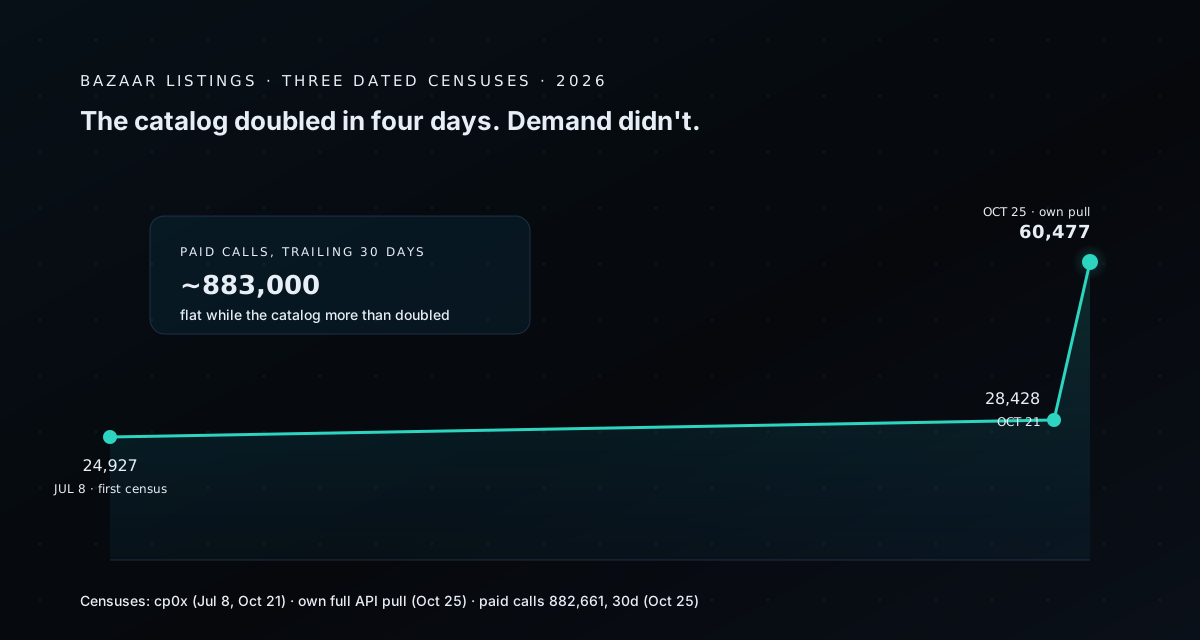
The catalog's growth rate is the loudest thing in it. The first published census of this discovery catalog, back on July 8, counted 24,927 listings. A third-party snapshot taken October 21 counted 28,428, which is about 14 percent growth over three and a half months, a respectable clip. Four days after that snapshot, on October 25, my own pull of the same API came back with 60,477.
Look at the spacing: 24,927 in July, 28,428 on October 21, and 60,477 on October 25. Whatever is feeding listings into this marketplace, it started feeding them by the tens of thousands in the final days of October.
The supply line and the demand line are different lines
To be fair to the people listing: the rail itself is not the problem, and the macro numbers say so out loud. Coinbase's facilitator alone reports more than 100 million x402 payments settled across Base and Solana. x402.org's counter reads 75.4 million transactions and $24.2 million of volume over 30 days. The meter hums. Anything you ask the rail to settle, it settles.
One honest note on the counters: x402.org's numbers were identical when I checked on October 20 and again on October 25. I stopped quoting that one as live. Part of reading this market is knowing which numbers move and which ones sit still.
And one honest note on my own census: I count what the API hands me, raw. A repeat of the same pull shows a few dozen duplicate URLs, nothing that moves a percentage. Other censuses may count differently, which is exactly why every number in this piece carries its date.
The wallets keep arriving, and the demand evidence keeps getting better. Chainalysis counted more than 138 million x402 payments on Base through July, 87 percent of them under a dime. The median wallet now goes from first funding to first payment in 18 minutes; in late 2025 that gap was 73 days. Two thirds of new wallets spend within the hour. These wallets are being built for a job that is already queued up.
But on my pull, the demand level is 882,661 paid calls across the whole catalog over the trailing 30 days. Supply more than doubled in the last week of October while the paid-call counter sits under a million. The buyers are coming. They just are not coming at the rate the listings are.
Where the payers are
The single busiest endpoint on the entire Bazaar is called AX1 Console. You send it a Base token address. It writes you a verdict: some onchain metrics, a plain-language take, and a shareable card. The listing says entertainment, not trading advice.
That endpoint took 208,617 paid calls in 30 days. It is 23.6 percent of all paid traffic in a catalog of sixty thousand listings. The number two endpoint is BlockRun.AI, pay-per-call chat completions, 88,606 calls, ten percent. Number three is a web search proxy. After that: smart-money feeds, token sends, agent workflows.
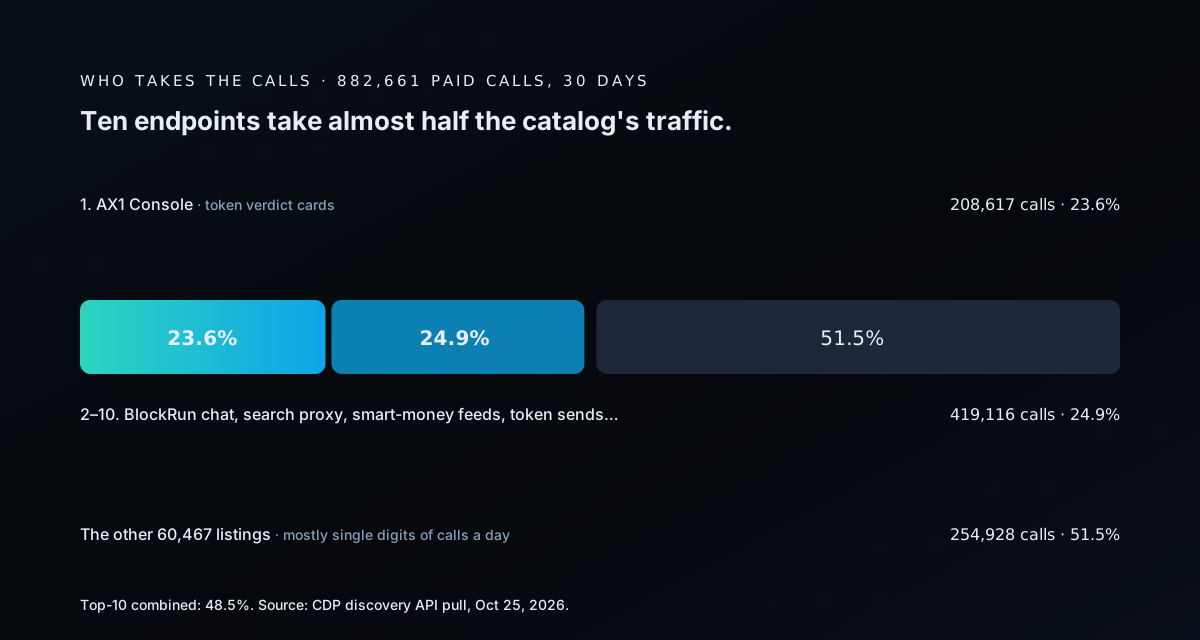
The top ten together take 48.5 percent. Strip them out and the other 60,467 listings split the remainder, mostly into single digits of calls a day.
Look at what the winners sell, because the pattern is the whole story. One obvious job. One input a buyer already has in hand, a token address or a prompt or a query. One result you can check or show someone. A price you do not think about. That is what legible means on this market, and legibility is what the buyers are paying for.
At the other end of the distribution sits a stranger pattern: a Chainlink workflow endpoint that took 12,802 calls from exactly two payers. That is not a market. That is a whale with a pipeline.
Six in ten listings have exactly one payer
Here is the number I keep coming back to. Of 60,477 listings, 38,184 have exactly one unique payer in the last 30 days. Not one payer per day. One payer, period. The median active listing's payer count is 1.
Another 1,841 listings were never paid even once. Only about 20,000 listings have more than one payer.
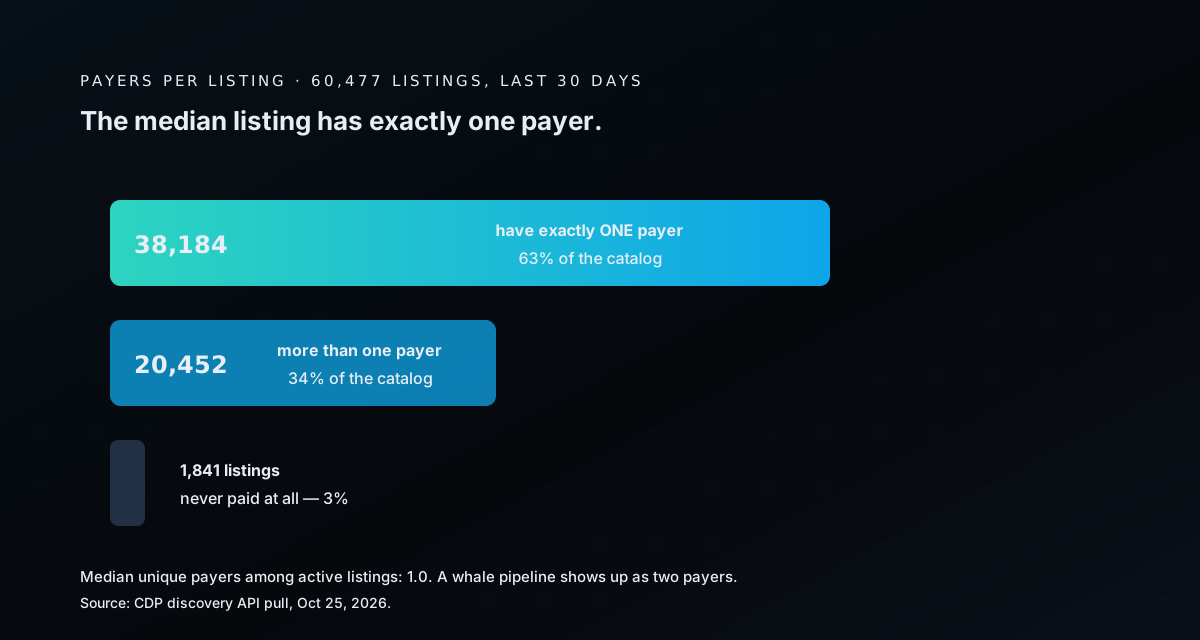
The market is not dead, and this is not a dead-catalog chart. Ninety-seven percent of listings were paid at least once in the last 30 days, and 23,307 of them were called on October 25 alone. Agents are paying, every day, across a huge surface. The volume is just not deep anywhere. Six in ten listings converted exactly one human decision, one trial, one "let me see what this does," and nothing after.
And a chunk of the catalog is not even trying to be a business. One seller fields 734 listings. Another has 487. When listing is free, catalog size measures typing speed. The land grab rewarded whoever shipped the most endpoints; the audit shows what all that shipping bought, which is almost nothing per endpoint.
Who moved while the catalog flooded
The seller side of the market keeps getting more serious, which makes the flat demand line stranger, not less strange.
Mastercard opened early access for Agent Pay for Machines at Cloudflare Connect on October 20. The demo is worth quoting in full: one approved budget, an AI agent, nine payments across two merchants. It bought research and eight images without asking a human for a card. Signed vouchers, guarantee now and settle later, still officially a pilot. Base's own post put the plumbing plainly: powered by x402 and USDC, settled on Base.
Cloudflare's Monetization Gateway is in closed beta on the seller side, answering 402s and settling in USDC through Coinbase's facilitator. The x402 Foundation is at 57 members, PayPal and Sui among the post-launch additions, with a former Amazon payments executive running it. Stripe and Tempo are pushing their own take on the same HTTP 402 idea, and Proof shipped an agent-identity standard that sits next to x402.
The standard is getting crowded. Parking lots do not grow malls unless somebody believes the cars are coming.
What the audit says to a seller
I run paid endpoints on this rail, so this is the part I act on.
Sell one legible job, not a catalog. The busiest endpoint in sixty thousand is a toy that does one thing with one input. The 734-listing shop is nowhere in the top ten. That comparison is the whole market in one sentence.
Go where buyers already cluster. The Bazaar ranks on complete descriptions, real schemas, example outputs. On a market with one median payer, discoverability is not marketing, it is oxygen.
Price for the trial, not the contract. Eighty-seven percent of x402 payments are under a dime. The first call is the audition. A price that makes the audition easy is how one payer becomes a repeat payer.
Keep receipts. The wallets arriving now arrive with a job queued and a budget behind them, and budgets get audited. A receipt that binds the task, the price, and the result is what survives that audit. This is the same close as my last two pieces because it keeps being true: our rail-watch brief sells for 0.05 USDC a call with an onchain receipt, and the weekly institutional tier exists because buyers with budgets ask for exactly that.
The honest close
Counts are not buyers. Chainalysis's own follow-ups point out that some share of x402 traffic is automated activity that is not really commerce, and my pull has the same limit: I can see calls and payers, not revenue. This is an anatomy of the market, not a revenue sheet.
But the shape is clear enough to act on. Sixty thousand listings produced about 883,000 paid calls, nearly half of them absorbed by ten endpoints, and the median listing converted exactly one payer. The land grab is over. The audit says who ate.
The next scarce thing on this market is not another endpoint. It is being the listing with payers.
Sources
- Coinbase CDP x402 discovery API (full catalog pull, October 25, 2026)
- cp0x: The state of x402 (published catalog censuses: 24,927 listings on July 8, 2026; 28,428 listings on October 21, 2026)
- Chainalysis: Inside North America's $3 trillion crypto economy: agentic commerce accelerates (Oct 14, 2026)
- Fortune: AI agents are on a shopping spree: Base x402 transactions eclipse 138 million (Oct 14, 2026)
- Mastercard: Agent Pay for Machines in action at Cloudflare Connect (Oct 20, 2026)
- Exchange.news: Mastercard's Agent Pay for Machines lets AI agents pay (Oct 24, 2026)
- Stablecoin Insider: Mastercard Agent Pay for Machines: how x402 payments settle (Oct 21, 2026)
- TechTimes: Mastercard opens developer APIs for AI agent payments built on x402 (Oct 21, 2026, incl. CDP facilitator 100M+ payments)
- Payzum: x402 ecosystem 2026: who supports x402, mapped by role (Oct 19, 2026, incl. 57-member foundation roster)
- Linux Foundation: Operational launch of the x402 Foundation (Jul 14, 2026)
- TRM Labs: Who's actually paying? Measuring AI agent payments onchain (Sep 2026)
- x402.org (counter viewed October 20 and October 25, 2026)